Category: Trip Report (Page 1 of 18)

Trip report – Lewis Farm – 4/29/26

Trip Report compiled by Abby Wolcott:

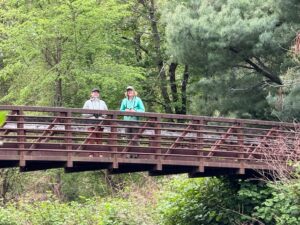
A dozen birders gathered at the top of Hill Street poised to explore the HAS Lewis Farm.  Abby led them down the hill to the sounds of silence.  Fortunately, that changed as bird calls filled the air.
We took the time to discuss the Merlin app and Doug Beach’s email about best practices.  Red-bellied woodpeckers called from across the preserve throughout the morning, and the ever-vocal tufted titmice seemed to be everywhere, calling out.  We heard pine warblers from the canopy but they did not reveal themselves.  The group paused after the Billy Goat Gruff Bridge to bask in the morning  sunshine.  We were rewarded by a pair of yellow warblers which were kind enough to light on several low branches in the sun allowing us to “oooh and ahhh”at their splendor.  Eagle -eyed Joan spotted a dark silhouette in the brambles and identified the bird as a rusty blackbird.  He proved to be a “lifer” for a few birders and he stayed posted on his branch for quite a spell.
 The vernal pool area was calling our name so we continued on.  We admired the understory and all the beautiful hues of green prompting a debate whether the color was spring green or leaf green or Granny Smith apple green.  Regardless, the woods were a vision.  We circled back again taunted by the pine warblers but they refused to be seen.  We heard a wood thrush and a white breasted nuthatch and started our way back.  We detoured around the pine tree loop and admired trillium on either side of the path.
As we climbed the Hillary Step, human banter took over for the birds.
One wonderful by-product of birding is meeting so many lovely people and getting acquainted as we wrestle with our binoculars.  All these folks are drawn to birds and this group in particular had it all: patience, kindness, knowledge and humor.  I missed both the birds and the birders as I headed home.
Species List:
Red-tailed hawk
Red-bellied woodpecker
Blue jay
Black-capped chickadee
Tufted titmouse
White-breasted nuthatch
Gray catbird
Wood thrush
American goldfinch
Song sparrow
Red-winged blackbird
Rusty blackbird
Northern yellow warbler
Northern cardinal

Roaring Brook Nature Center: Trip Report – April 26, 2026

The forecast for clearing skies did not materialize, and the morning
of April 26th dawned gray, dreary and drizzly.
Nevertheless, at 7 am, 14 hardy birders met in the Roaring Brook Nature Center
to see what the spring migration had to offer.
Sadly, it was not much as the cool, damp conditions were not favorable to
birdsong, and a week-long period of winds from the north had not spurred
small songbirds to move against the wind.The few birds around the Nature Center building were keeping
low in the brush, not wishing to expose themselves to the
less than ideal weather conditions, and by the time
we reached the fields, our list was but half of what had

been seen on a bird walk the previous day.
Other than a few breeding-plumaged goldfinches
chasing each other around, and a couple of bright crimson
male cardinals, there was not much movement.
A vocal gray catbird was our first real migrant, but
things did not improve much as we were unable to find the
bluebird pair seen the previous day.
Leaving the fields and entering the woods,
we finally began to hear and even see a few birds as a
singing blue-headed vireo and a group of brightly-plumaged
male yellow-rumped warblers were found high in the trees.
As we approached the pond, the sky finally began to
brighten just a tiny bit, and we were able to add belted kingfisher,
brown creeper and blue-gray gnatcatcher to our list.
Our nicest observation, and a nice way to end our walk, was a very
obliging male yellow-bellied sapsucker, who posed for photos while
he drummed away at close range on a dead standing tree.
A meager 28 species was seen/heard during the trip, far below what
would be expected on this date.A trip list follows.

Jay Kaplan, Trip Leader
Trip Birds
1. Mourning Dove
2. Red-shouldered Hawk
3. Red-tailed Hawk
4. Belted Kingfisher
5. Yellow-bellied Sapsucker
6. Red-bellied Woodpecker
7. Downy Woodpecker
8. Northern Flicker
9. Eastern Phoebe
10. Blue-headed Vireo
11. Blue Jay
12. American Crow
13. Black-capped Chickadee
​14. Tufted Titmouse
15. Ruby-crowned Kinglet
16. White-breasted Nuthatch
17. Brown Creeper
18. Blue-gray Gnatcatcher
19. Northern House Wren
20. Carolina Wren
21. Gray Catbird
22. American Robin
23. American Goldfinch
24. White-throated Sparrow
25. Song Sparrow
26. Louisiana Waterthrush
27. Yellow-rumped Warbler
28. Northern Cardinal

Trip Report – Silver Sands Bird Walk

On Sunday, March 29th twelve birders joined Ernie and me on a beautiful morning bird walk.
We slowly walked about three miles enjoying the birds and the fresh ocean air.
We missed many of the common local birds but the miss that surprised me the most was the Clapper rail. Every year we see them or at least hear them. Maybe the hard winter is to blame.
Some of the spots that we normally enjoy and find birds were blocked by phragmites.
The most celebrated birds were a pair of Oyster catchers that were feeding by the shore next to the boardwalk.   The group also enjoyed the call of the Brant’s.
We totaled 39 species, but we always wish for more.
Thank you.
Maggie Peretto
Manchester, CT

Hartford Crow Roost Trip Report, Dec. 6, 2025

Hartford Crow Roost Trip Report, Dec. 6, 2025

We met at 4 pm on Saturday, Dec. 6, outside the Walmart in the Flatbush Ave. shopping center across from the ramps to Rte. 84.  Binoculars around our necks helped us to find one another, a convivial group of about 20, among the Christmas shoppers.  Crows were flying over us from the northeast, under a mostly cloudy sky, with the temperature near freezing and not much wind.  We circled up to exchange names and decided to drive a couple of blocks south to the Hartford Housing Authority, where the crows seemed to be heading.  When we got there, we stood near the back of the building to see crows landing in the nearby trees: thanks to Celeste Echlin for the great photos that follow!

A German shepherd, I thought, walked out along the edge of the lawn (why had someone brought their German shepherd?)

Oh… not a German shepherd!  Thank you, Celeste!

We had a good look at the coyote, and vice versa!

From the overlook in front of the building, we could see a very long line of crows continuing to fly in from the northeast.  Large groups of crows were also flying in from the south and west to land in trees west of Newfield Avenue.  We moved on to our next stop, at the intersection of Dexter and Reed Avenues, a block west of Newfield.  Crows from the east, south, and west landed by the hundreds on the ground next to industrial buildings, and by the thousands in the tops of trees along the length of Reed Avenue.  Periodically, large groups of crows started cawing loudly in the trees, and then flew up, cawing, to circle overhead, only to land again in the same trees, joined by newly arriving crows.  Crows were still flying into the area as dusk fell; our count along Reed Ave. was about 7,500 crows.  When we left, crows were gone from the Hartford Housing Authority trees; some may still have been in trees along the South Brook Park River, but it was too dark to have seen them.

Many thanks to everyone who joined us and helped to enjoy the spectacle!

A little background, and updates from the Christmas Bird Count and yesterday (Feb. 6):

Crows assemble from dispersed foraging locations to sleep (roost) in large groups in winter, in part for protection from predators like Great Horned Owls. A large group has many sets of eyes and ears to detect predators, groups may harass predators and chase them away, and even if the conspicuous group attracts predators that eat a few crows, most will escape predation: crow predators have large territories and are not very social, so there won’t be a nearby waiting group of hungry predators!  The exact roost area may shift from night to night, so it is likely that incoming crows look and listen for where other crows seem to be gathering, and the crows that fly up calling from trees and circle the roost area near dusk are signaling incoming crows to join them.  Roosting in groups may also help hungry crows to find food the next morning, by following other crows that leave the roost rapidly, flying in a consistent direction.

Since I began watching Hartford crows in the early 2000s, the winter roost has been near Rte. 84, in locations between downtown Hartford and eastern West Hartford.  Large numbers of crows are roosting together between about mid-November and mid-March, when crows that migrated from farther north start to head back to their breeding areas.  Jay Kaplan leads the crow roost count for the Hartford Audubon Christmas Bird Count, and has a wealth of historical knowledge, including that the roost has been as far from its current location as the Copaco Shopping Center/Plaza in Bloomfield.  I thank Jay for teaching me crow-counting techniques: 1) it’s helpful to count a flying flock as they pass an easily defined location like a light pole; and 2) to estimate  large numbers of crows in flight or in trees, first count crow by crow to figure out what 10 crows looks like; then count by groups of 10 to know what 100 looks like; and then count by 100s to know what 1000 looks like.  Over the last 20 years, the estimated number of crows in the Hartford roost has ranged from 6,000 (in 2007) to 28,000 (in 2012); numbers often fluctuate considerably from year to year.  In 2024 we estimated 21,000 crows in the roost, while in 2025, only 12,000 (more than on December 6, likely in part because more observers at more vantage points were watching crows flying into the roost).  There may have been a second roost in 2025 that included some of the crows we counted in 2024, perhaps near Newington; on early mornings in January 2026, I saw groups of crows flying over Newington both from the east, the direction of the Hartford roost, and from the west, possibly from another roost.

In recent weeks, the roost seems to have moved southwest, closer to New Britain Avenue and New Park Avenue.  On the night of February 6, many thousands of crows were flying back and forth across New Britain Avenue after sunset. Many settled along Brixton Street on rooftops of low West Hartford Public Works buildings, and in nearby trees, but hundreds to thousands were still in the air when it got too dark to see them.

Hoping you can join us on the crow roost trip, and on the Christmas Bird Count crow count, next December: all are welcome!

Submitted by Sylvia Halkin, Trip Leader, with credit and thanks to Celeste Echlin for the great photos, and to Celeste, Sam Walker, and Roberta Gowing for submitting e-Bird checklist and report S287590180.


Trip Report – Cape Ann/Newburyport, Massachusetts 1/17-1/18/2026

Cape Ann/Newburyport, Massachusetts
January 17th and 18th 2026

Attendees Wendy and Roy Parsons,Deana Smith, and her mother Carol ,Erin Mahoney, Bill Kelly and his daughter Tilly, Sarah Faulkner,Will and Gabrielle Bugden, Annette and Bill Pasek .

Saturday morning started off cold and cloudy 30°. It warmed up to 34°. We started our morning in Rockport Massachusetts. We went back to the hotel for lunch then off to Gloucester Massachusetts, the afternoon. We had light rain starting around 2 o’clock in the afternoon. We continued around Gloucester until around 3:30. We saw the following Birds.
Common Loon, red breasted merganser, long tailed duck, black scoter,common Eider, surf scoter,rock doves, American Black  Ducks, purple sandpipers, mallards, Canada geese, American Crow, turkey, double crested cormorant, greater Cormorant, white wing scoter, Harlequin, Cardinals, Blue Jays, song sparrow, Ruddy duck, white throated sparrow, Towhee, greater black back gull, lesser black back gull, Bufflehead, common golden eye, Gadwalls, northern Mockingbird, Carolina wren, herring gull, ring bill gull, bald eagle, Brant, dark eyed Junco, black cap chickadee, white breasted nuthatch.

Sunday we went to Newburyport, Massachusetts. It was cold and cloudy like Saturday 34°. we we saw the following Birds.
House finch, mourning dove, northern Harrier, Sanderlings, starlings, razorbill, robin, Cedar waxwing, yellow rump warbler, American Widgeon,
Eurasian Widgeon, tree, sparrow, bald eagle and a snowy owl.
Due to the weather forecast, people decided to leave around 2 PM. Bill Kelly and his daughter Tilly decided to go to Salisbury Beach to look for the long eared owl that was being reported there. They were successful!

Great birding weekend, a total of 51 species.

Wendy, Parsons

Long Island NY Trip Report – November 2025

This past weekend we met at Jamaica Bay Wildlife Refuge at 10 a.m.. The refuge headquarters was closed due to the government shutdown but the trails were open. Long Island is known for winter waterfowl and we quickly picked up 12 species of duck including a large flock of Ruddy Duck, Green-winged Teal, Northern Pintail, Northern Shoveler, Gadwall, American Wigeon, Ring-necked duck, Greater Scaup, and Hooded Merganser. The sound of Brandt, Canada Geese, and a Killdeer filled the air. A Northern Harrier,  Double Crest Cormorant and a Great Blue Heron flew over head, while Horned Grebes dove in the open water of the bay.  We had a leisurely walk around the West Pond and through the woods back to the parking lot where we decided to try to chase the Tundra Bean Goose rather than build our list.  We drove to Beaver Lake on the North Shore near Oyster Bay and were rewarded with a good view of the bird from an elevated vantage point. 
 
We crossed back to the South Shore and birded Point Lookout where we spotted American Oyster Catchers, Black-bellied Plover, and had a brief look at a Godwit on a distant mudflat.  Unfortunately it did not stick around for identification. We drove to the other side of the inlet to the Coast Guard Station at the end of Jones Beach.  The sixty degree weather had brought out many families to dig out clams and crabs so the birds had dispersed.  We were able to add White Winged and Surf Scoters.  We headed toward hotel as the sun set.
 
Rain was scheduled to begin at 2 p.m. the next day, so that evening we decided to do more chasing on Sunday to explore areas that have not been visited on previous Long Island trips.  
 
The next morning we drove a short distance to Connetquot River State Park which opened at 8.  We were looking for the drake Eurasian Wigeon which we eventually found among a flock of American Wigeon. Many of the same species that we had seen at Jamaica Bay were here, along with over 30+ Mute Swans.  We had a number of land birds which attracted a Merlin that landed in a nearby tree.  As we left the State Park Headquarters, a lone Turkey fed in a field. 
 
Our next stop was Robinson Pond in East Patchogue in search of a reported “European Goose”.  This goose was most likely a domesticated or escaped Grey Lag Goose.  The pond however was covered with many species of duck including a number of beautiful drake Northern Pintail.  A Belted Kingfisher called from across the pond.  
 
Our next stop was Coopers Beach in Southampton.  Here, we turned up 5 Lesser Black-backed Gulls, and a Laughing Gull, among many Great Black-backed, Herring and Ring-billed Gulls. 7 Sanderling patrolled the beach.
 
As we arrived at our final stop it was nearing 2 o’clock and rain began to pick up and the skies were becoming increasingly darker.  Despite the rain, we were able to spot our final target bird…Purple Gallinule.  
 
Although we only birded for 12 hours, we were able to identify 71 species with 2 of them having never been seen on the HAS Long Island trip.
Peter Stephan

A.W. Stanley Park Bird Trip Report – October 19, 2025

A.W. Stanley Park trip report, October 19, 2025

At 9:30 a.m. 14 of us met up at A.W. Stanley Park, and after brief introductions and Robert Rickman generously volunteering to keep track of and submit the e-bird list for our trip (thank you, Robert!), we heard “chuff” calls from the trees at the back of the parking lot.  Oho, a Red-bellied Woodpecker was moving around on bare upper branches of a tree.  It stayed there long enough for us to practice our bird-location-describing skills, to do some comparisons of binoculars, and to have us looking in the right direction when a Pileated Woodpecker flew by, white wing spots flashing.

We walked along the west edge of the marsh and stream, and saw a Ruby-crowned Kinglet, a Yellow-rumped Warbler, Song Sparrows, American Robins, a Northern Flicker, and perched and flying Mourning Doves and Blue Jays.  We heard Downy and Hairy Woodpeckers, another Red-bellied Woodpecker, and a Carolina Wren. We also got quick looks at sparrows we couldn’t identify, and two gulls high overhead.  In an open area with cattails and grasses in the middle and trees on the edges, a Blue Jay chased a calling Pileated Woodpecker back and forth in our full view (probably not the same one we’d recently seen, as it had flown off in a different direction: it’s an unusual treat to get good looks at one Pileated Woodpecker, let alone two!).

In the orchard area we saw at least 10 Cedar Waxwings eating berries in a Juniper = Eastern Red Cedar tree.  Tracey noticed that one of them, instead of the usual yellow band across the tail feather tips, had a bright orange band.  Thank you for guiding us all to see that bird!  The most likely cause of the orange coloration is thought to be Cedar Waxwings eating the red berries of Morrow’s honeysuckle, an introduced ornamental species, as their tail feathers are growing; red pigment from the berries is then deposited as the feather tips grow, along with the normal yellow pigment.

Near the bridge over the spillway between the marsh and the pond, a group of 30 or more Cedar Waxwings were quite actively flying within and between juniper trees.  All the Cedar Waxwings I saw looked like young of the year, with mottled or somewhat streaked breasts, and lacking red waxy tips on their wing feathers.  The Birds of the World species account reports that in central New York, adults may migrate south a month before young of the year, a likely explanation for the absence of adults in our sightings.  Cedar Waxwings without active nests seem to move around widely at all times of year to find fruit crops. They can be found in Connecticut year-round, but are in the northern part of the species range (which extends into Canada) only in the breeding season, and in the southern part (from the southern U.S. through Central America) only at colder times of year; they don’t reliably return to the same breeding or wintering sites, so not much seems to be known about whether the birds we saw are likely to have been hatched locally, or are staying for the winter, or were just passing through on migration.

At the pond, we heard a Belted Kingfisher and saw a group of 2 white adult and 4! grayer young-of-the-year Immature Mute Swans, Mallards, a Black Duck, and a Ring-necked Duck, as well as sunning turtles.  Those in our group who could stay longer got to visit the Traprock Ridge cliff overlooking the pond, and to spot a flyover Red-tailed Hawk.

Other birds we saw or heard well enough to identify were a flying Cooper’s Hawk, at least one Canada Goose in flight, European Starlings, Black-capped Chickadees, Tufted Titmice, House Sparrows, White-throated Sparrows, and a Northern Cardinal.  We had a total of 28 bird species, including the (likely Ring-billed) gulls.

The wind was calm, temperatures ranged from the upper 50s to mid 60s, and cloud cover varied, with some sunny stretches.  We had a good time sharing what we were seeing with one another: I am grateful for the excellent bird spotters and location-describers who were with us, and for everyone’s congeniality!

Submitted by Sylvia Halkin, Trip Leader

Farmington River Bird Walk Trip Report – October 11, 2025

October 11th Farmington River Park bird walk in Bloomfield.  The walk started at 8:00am and ended at 11:30am.  The weather was perfect.  Sunny and a comfortable temperature.
Twenty-two species of birds were seen or heard by ear:
1 Goldfinch
5 White-throated Sparrows
8 Golden-Crowned Kinglets
2 Northern Flickers
3 American Robins
1 Killdeer (Heard)
4 Tufted Titmouse
2 Downy Woodpeckers
2 Red-bellied Woodpeckers
1 Pileated Woodpecker
1 Yellow-bellied Sapsucker
4 Eastern Bluebirds
10 Yellow-rumped Warblers
3 Turkey Vultures
1 Sharp-shinned Hawk (Probable)
3 Carolina Wrens
1 Belted Kingfisher
2 Black-capped Chickadees
1 White-breasted Nuthatch
5+ Blue Jays
3 Wood Ducks (Heard)
2 Bald Eagles (Heard)
Birds picked up by Merlin but not verified by ear or seen:
1 Hairy Woodpecker
2-3 Brown Creepers
1 Eastern Phoebe
1 Great Horned Owl
1 Blue-headed Vireo
Mike Rosano

Raymond Brook Preserve – Trip Report – October 4, 2025

Raymond Brook Preserve, Hebron. October 4, 2025- 7:30 am

After a minor hiccup involving an incorrect street address, twenty intrepid birders gathered on a spectacular fall morning, their vehicles nearly filling the tiny parking lot of Raymond Brook Preserve. What a turnout, from both participants, and Mother Nature!

Though certainly not disappointing, birding throughout much of the Preserve was a bit slow. Highlights included Eastern Towhee, Black- Throated Green Warbler, three Purple Finch, and a very cooperative Monarch butterfly. We were also treated to a plethora of Cedar Waxwing, Gray Catbird, Blue Jay, and White-Throated Sparrow. Some glimpsed a Yellow- Rumped Warbler. Notable misses for the location were all other warblers, Eastern Bluebird, and Turkey Vulture.
As we walked, Amateur Historian Will provided lessons on past and current land use issues of Raymond Brook and adjacent properties. We admired the two Pollinator Pathway gardens, and many of us swapped native planting and conservation tips.
Almost half the group then reconvened for breakfast around the corner at The Flour Girl Cafe, where we continued our conversations, this time with coffee.
Respectfully submitted,
Gabrielle and Will Bugden
Link to full eBird list: https://ebird.org/checklist/S277174191

Glastonbury Meadows Trip Report, September 27, 2025

Glastonbury Meadows Trip Report, September 27, 2025

Ten birders joined us for the HAS walk in Glastonbury Meadows on Saturday, September 27, from 7 a.m. to 12 p.m. Walking the riverside trail leading south from behind town hall was relatively uneventful, though we all paused to admire an adult Bald Eagle perched across the river. As we entered the expansive farm fields, an early morning mist hung over the landscape and dew droplets defined the many spider webs in the grass. The sun quickly burned off the mist, followed by rising temperatures that had many of us shedding layers later to avoid overheating! Soon after seeing our first Lincoln’s Sparrow in the roadside brush (total of 5 for the day) we came upon a pocket of birds in the tall trees along the river. Getting good views was difficult, but our persistence was rewarded with glimpses of several warbler species, a Warbling Vireo, and an Eastern Wood Pewee. We spent the bulk of our time walking slowly up and down the weedy vegetable fields, flushing numerous sparrows (dominated by Savannahs), Bobolinks, Indigo Buntings, Palm Warblers, and Common Yellowthroats. An Orange-crowned Warbler was an exciting find, appearing briefly in the weeds right in front of the group. Another nice surprise was a flock of 8 Brant flying southbound high overhead. We’ve found this species on only 6 occasions in the Meadows (post 2002; all flyovers). Overall, it was a relatively quiet morning in the Meadows for late September, but we recorded a nice variety of birds, with over 50 species for the trip.

Andrew Dasinger and Bill Asteriades, Co-leaders

« Older posts

© 2026

Theme by Anders NorenUp ↑